What Does 6% Body Fat Look Like on a Man?
What 6% body fat can look like on a man, who may briefly reach it, and the trade-offs that disappear from most before-and-after posts.
Health Notice
6% body fat is achievable but hard to maintain. Most men at this level are competitive athletes or bodybuilders. Sustaining it long-term may affect testosterone and recovery.
See what 6% body fat looks like on you
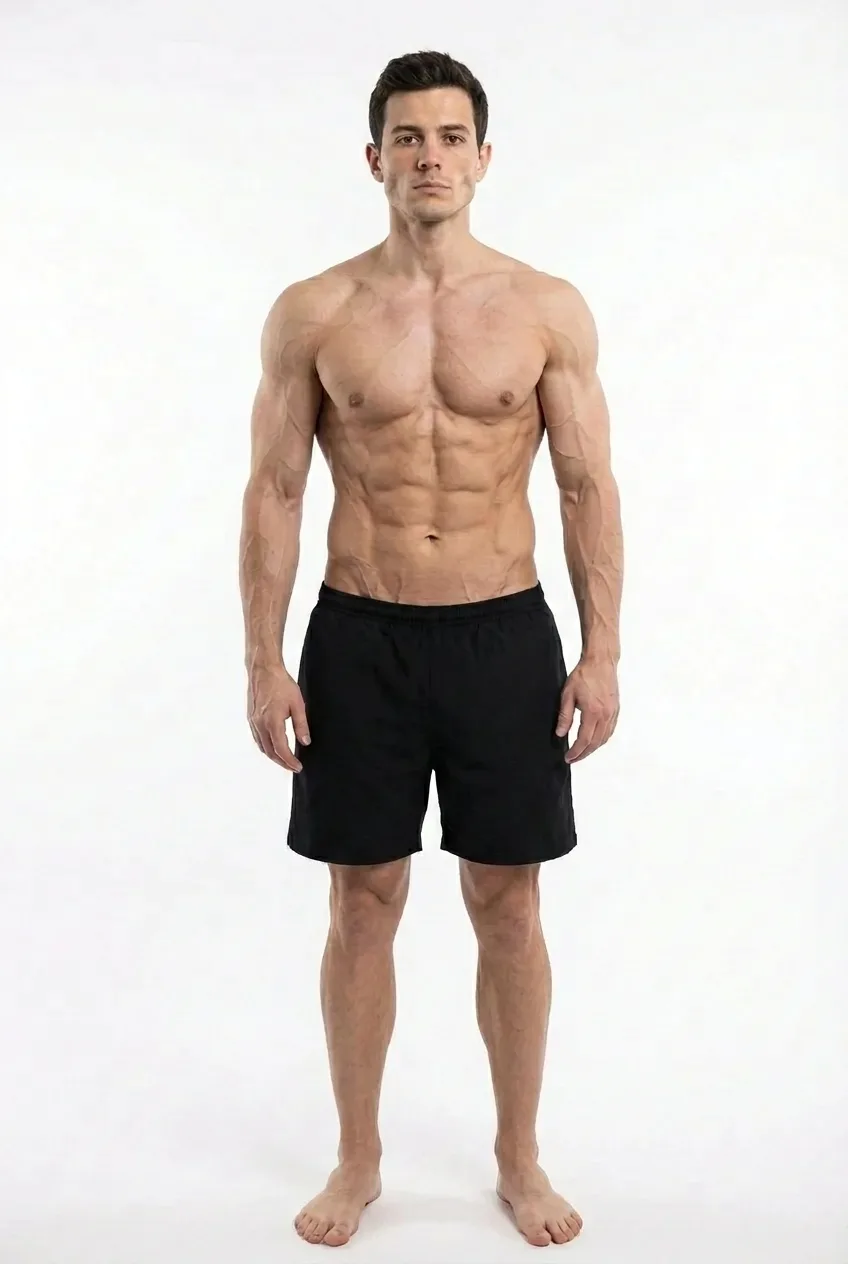
The photo above shows roughly what 6% body fat looks like on a man. But your body is your own. Frame, muscle, and where you store fat all change how a given body fat percentage actually looks.
FitCommit's AI Body Scan uses three phone photos to estimate your body fat and lean mass. After Photo creates a motivational preview of what progress could look like at 3, 6, or 12 months. It is not a guaranteed outcome.
See your future physique→What 6% Body Fat Looks Like
Very lean and defined. Clear six-pack abs. Visible vascularity on arms. Muscle striations on chest and shoulders. Minimal subcutaneous fat anywhere.
Contest-ready bodybuilders like Chris Bumstead, Brandon Curry, and Hadi Choopan typically compete at 6-8% body fat. Even elite natural bodybuilders like Jeff Nippard have been measured in this range on stage day.
Body Composition at 6%
Based on a 5'10", 180 lb man:
| Metric | Value |
|---|---|
| Total Weight | 180 lbs (82 kg) |
| Fat Mass | 10.8 lbs (4.9 kg) |
| Lean Mass | 169.2 lbs (76.7 kg) |
| Body Fat Percentage | 6% |
Daily Calorie Needs (TDEE)
Estimated using the Katch-McArdle formula based on 169.2 lbs of lean mass. Because Katch-McArdle uses your body fat percentage, knowing your real number makes your calorie target far more accurate. Run your own with the free TDEE calculator:
| Activity Level | Calories/Day |
|---|---|
| BMR (Basal Metabolic Rate) | 2,027 |
| Sedentary (desk job) | 2,432 |
| Lightly Active (1-3 days/week) | 2,787 |
| Moderately Active (3-5 days/week) | 3,142 |
| Very Active (6-7 days/week) | 3,497 |
Prefilled calorie estimate
Calculate your TDEE at 6% body fat
Sex and body fat are filled from this page. Add your current stats to estimate maintenance calories with Katch-McArdle, then continue to the full calculator for advanced activity, macros, and planning.
Male
6% body fat
Estimated maintenance
3,143
calories per day
BMR
2,028
Cut target
2,514
Lean bulk
3,457
Defaults start with the reference body used in this guide. Edit them to match you.
Open full TDEE calculatorSuggested Macros
Based on moderate activity (3,142 cal/day):
How Long to Reach 6%
| Starting From | Fat to Lose | Est. Weeks | Rate |
|---|---|---|---|
| 15% body fat | 16.2 lbs | ~22 weeks | 0.5-1 lb |
| 20% body fat | 25.2 lbs | ~34 weeks | 0.5-1 lb |
| 25% body fat | 34.2 lbs | ~46 weeks | 0.5-1 lb |
| 30% body fat | 43.2 lbs | ~58 weeks | 0.5-1 lb |
How to Reach 6% Body Fat
Reaching 6% body fat means losing fat while holding on to lean mass. These are the levers that matter, in order of impact:
1. Eat in a moderate calorie deficit
Aim for roughly 300 to 500 calories below your maintenance (about 3,142 cal/day at moderate activity for this body). Larger deficits strip muscle and stall progress. Get your exact number with the free TDEE calculator.
2. Prioritize protein
Eat about 169 g of protein per day to protect muscle while you lose fat. Spread it across your meals. Set carbs and fats around it with the macro calculator.
3. Lift weights 3 to 4 times a week
Progressive resistance training is what keeps the muscle that makes 6% look lean and defined rather than simply smaller. Train each major muscle group and add load over time.
4. Add daily movement
8,000 to 10,000 steps a day, plus two or three optional cardio sessions, widen your deficit without cutting food further, which keeps training and recovery intact.
5. Be patient and consistent
A safe rate is about 0.5 to 1% of bodyweight per week. See the timeline above for how long that takes from common starting points. Aggressive crash diets rebound and cost you muscle.
Note: 6% is a very lean, athlete body fat that typically requires contest-prep discipline and is hard to hold year-round. Most people look and perform their best a few points above it.
How We Estimate Body Fat (and Its Limits)
The photo and ranges on this page show a typical presentation of 6% body fat. Real appearance varies with frame size, muscle mass, where you store fat, age, and lighting, so two people at 6% can look different. The percentage itself is an estimate: home methods like the U.S. Navy circumference formula are typically accurate to within 3 to 4 points, while DEXA and hydrostatic weighing are more precise but require a clinic. The consumer bioimpedance (BIA) scales most people own are the least reliable of all, often swinging several points with hydration alone, which is why a photo-based estimate is usually a more consistent way to track change over time.
These guides are educational, not a medical diagnosis or a substitute for assessment by a qualified professional. Our figures and methodology are reviewed by Andrew Menechian, Head of Fitness; see the full body composition methodology for formulas and sources.
How FitCommit Measures Body Fat
Take three photos: front, side, and back. FitCommit estimates body fat, lean mass, and measurements so you can follow the weekly trend.
Try it free →Track body-fat changes over time
Three-photo AI estimate with body fat, lean mass, and weekly trends.
Frequently Asked Questions
How do I measure my body fat percentage?
Common methods include clinical DEXA scans, InBody or BIA devices, calipers, tape measurements, and photo-based estimates. Each uses a different proxy and has different limitations. FitCommit has not published a DEXA validation study or a FitCommit-specific error margin, so use it for consistent trend tracking rather than as a clinical measurement.
What is the difference between body fat percentage and BMI?
BMI only uses height and weight. It cannot distinguish between muscle and fat. A muscular man at 6% body fat could have the same BMI as someone with much higher body fat. Body fat percentage is a more accurate measure of body composition.
How fast can I change my body fat percentage?
A safe rate of fat loss is 0.5-1% body fat per month, depending on your starting point and deficit size. At lower body fat levels, progress slows and requires more precision. Muscle preservation requires adequate protein and resistance training.
What exercises are best for reducing body fat?
No exercise targets specific body fat areas. Fat loss comes from a calorie deficit. For body composition, combine resistance training (to preserve muscle) with moderate cardio. At 6% body fat, prioritize heavy compound lifts and limit excessive cardio to protect muscle mass.
More in Athletes
Related Guides
Cutting Guide
Deficit levels with timelines and calorie targets for fat loss
Body Recomposition
Build muscle and lose fat at the same time
BMI Lookup
BMI for every height and weight combination with health context
How Long to Lose Weight
Realistic timelines for any weight loss goal
Daily Calories
How many calories you need per day by age, gender, and activity
Compare Methods
Side-by-side comparisons of body fat measurement methods
See What Your Body Fat Really Is
Take three photos to estimate body fat and lean mass, then connect the result to your calorie targets, After Photo, and weekly trend.
Try FitCommit Free